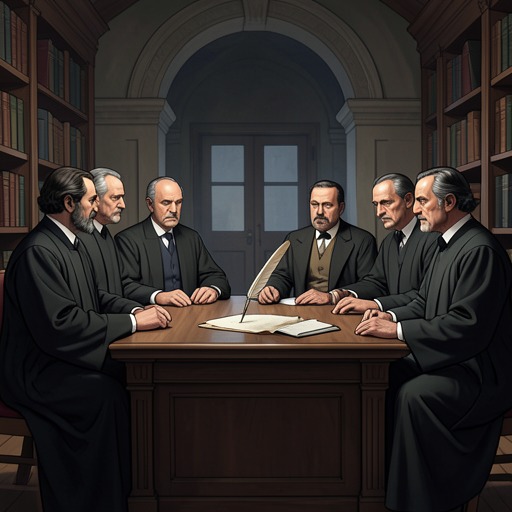
American Constitution approval process
Federalist PapersThe Ratification of the United States Constitution was a contested process and, in the argument presented here, a choice between an imperfect but amendable federal plan and the mounting dangers of continued national weakness. The proposed Constitution joined popular authorization to the states’ distinct political standing: it was federal in the act of ratification, mixed in the sources of governmental power, and designed to replace a Confederation whose measures could stall when thirteen sovereign wills failed to concur. Its advocates urged adoption not as a declaration of perfection but as the necessary beginning of a system that experience and later amendments could improve.
Crisis and the Case for Adoption
The case for ratification began with a failure of execution. Under the Confederation, important national measures depended on the concurrence of thirteen states and on their administrations carrying those measures out. The states’ uneven compliance encouraged those meeting their obligations to ask why they should bear more than their share. One by one, support receded; the resulting defaults brought the machinery of national government nearly to a stop. The crisis was therefore presented not simply as a defect in political theory but as accumulated experience of a system unable reliably to act.
That experience gave urgency to the argument for a new plan. The Confederation’s deficiencies had become apparent only in practice, Madison observed: among the many objections raised when the Articles were first submitted, the central defect revealed by experience had not been identified. The point supported a caution about constitutional judgment. Political arrangements could contain errors that no amount of advance reflection would expose; actual trial might be required before their consequences became visible. The proposed Constitution, accordingly, was not defended as immune to error, but as a response to a demonstrated emergency whose continuation carried its own risks.
Madison framed the convention’s task against the same background of crisis. The delegates, he argued, understood both the urgency of reform and the public’s intense expectation that their deliberations would produce it. Their authority had been advisory and recommendatory: the plan could have no force unless those to whom it was addressed approved it. This distinction allowed him to defend the convention’s initiative without treating its proposal as self-authorizing. The proposed system was offered for popular judgment, not imposed in place of it.
A Federal Act and a Mixed Government
The argument over whether the proposed Constitution was national or federal turned first on who would ratify it and in what political capacity. Ratification was to come from the people, acting through specially elected deputies, but not as one undifferentiated national electorate. They would act as the peoples of their respective states, each state a distinct and independent political community. The founding act was therefore federal in this account: no majority of the Union’s population, or of the states, could alone bind the rest through the ordinary rule of majority decision. Each state would be bound by its own voluntary act.
The government’s ordinary institutions complicated that classification. The House of Representatives would derive authority from the people and represent them by population, giving the system a national feature. The Senate would represent the states as political equals, retaining a federal feature. The executive, too, had a compound basis: states would participate in choosing the President in their political character, while their allotted votes reflected both equality among states and differences in population; in an eventual election, representatives would vote as delegations of distinct states. The proposed government thus could not be reduced to either a wholly national or a wholly federal model. Its structure combined the two principles in different institutions and stages of decision.
The distinction mattered because it defined the compact’s political foundation without erasing the national government it proposed to establish. State participation in ratification did not mean that the resulting government would be merely a league dependent on state cooperation for every act. In the defense of the plan, the new government would possess authority to operate within the powers entrusted to it, while the states retained their own political existence and a continuing role in the constitutional arrangement.
Authority, Limits, and Constitutional Interpretation
The clauses authorizing Congress to make laws necessary and proper for carrying its powers into execution, and declaring the Constitution, its laws made pursuant to it, and treaties supreme, were attacked as instruments for destroying state governments. The defense answered that these provisions did not create an unlimited authority. A federal government vested with specified powers would necessarily need laws to carry them out, and laws made within those powers would need supremacy; otherwise the arrangement would amount only to a treaty resting on the parties’ good faith, not a government capable of exercising political power.
That supremacy was expressly confined to laws made pursuant to the Constitution. A measure outside the delegated powers would not become valid merely because Congress enacted it; it would be an usurpation of the authority reserved to the states. The argument made the distinction concrete by imagining Congress altering a state’s law of descent or abrogating a state land tax under the pretext of protecting federal revenue. Either action, it contended, would exceed federal jurisdiction and invade state authority. The clauses were thus presented as establishing effective federal government while leaving constitutional boundaries in place.
The same reasoning addressed who judged whether a federal measure was necessary and proper. The national government, like any government, would judge the proper exercise of its powers in the first instance; ultimately, the people who had created it would judge whether it had exceeded its authority and could take prudent measures to redress the constitutional injury. The proposed Constitution’s written limits were therefore not described as self-enforcing. Their operation depended on the distribution of authority and, in the last resort, popular judgment.
Judicial independence formed another part of this account of constitutional limits. In a limited Constitution, specified restrictions on legislative power could be preserved only if courts were able to treat acts contrary to the Constitution as void. That judicial function did not make judges superior to the legislature: the legislature, like any delegated authority, remained bound by the commission under which it acted. A legislative act contrary to the Constitution could not be valid without making the representatives superior to the people who had authorized them. The courts’ independence was accordingly presented as a means of keeping constitutional restraints meaningful, not as a grant of authority above the people.
Representation and Checks on Power
The defense of ratification also treated representation as a chain of public trust. The electors of the federal representatives would be the same broad body of people entitled to choose the corresponding branch of their state legislatures; wealth, learning, family name, religious faith, and civil profession were not to bar a citizen from popular choice. Representatives selected through that process were expected to have earned their constituents’ confidence, and the honor and esteem conferred by election were described as motives for fidelity. Popular dependence supplied the primary control over government, though not the only one.
The Constitution’s internal restraints addressed the danger that dependence on voters alone could not remove. To prevent the gradual concentration of powers in one department, those administering each branch needed both constitutional means and personal motives to resist encroachment by the others. The argument’s succinct principle was that ambition must counteract ambition: officeholders’ interests should be connected to the constitutional rights of their offices. Separate departments would check one another through rival institutional interests, while independence in matters such as compensation would help prevent one branch from controlling another in practice. The design did not assume virtuous officials; it sought to make the structure work despite ordinary human motives.
That institutional logic complemented the mixed federal and national structure. Power was divided among governments and among departments within government, so that no single point of control would determine the whole system. The people remained the original source of authority, but constitutional arrangements supplied auxiliary precautions between elections. Ratification was defended as establishing a government capable of governing and, at the same time, obligated to restrain itself.
Ratification, Amendment, and the Choice of Timing
The rule that conventions in nine states could establish the Constitution among the states ratifying it was defended as a way to prevent one state from holding the essential interests of the whole at a standstill. The express authority of the people, rather than unanimous legislative assent, was said to give the new Constitution its validity. Requiring all thirteen states would have exposed adoption to the caprice or corruption of a single member, a danger made especially salient by the Confederation’s own history of delay and nonconcurrence.
The argument for adopting first and amending later rested on a difference in the scale of the decisions. Any change made before adoption would produce a new plan that had to receive the assent of all thirteen states for establishment throughout the Union. Once the Constitution was adopted, amendments could be proposed singly rather than bundled into a comprehensive settlement of every competing interest. The text contrasted the thirteen states required for a revised initial plan with the nine states said to be sufficient for subsequent alterations, describing the odds as thirteen to nine in favor of amendment after adoption.
The amendment process was also presented as binding rather than discretionary. If legislatures of two-thirds of the states applied for a convention to propose amendments, Congress would be obliged to call one; proposed amendments would become valid upon ratification by three-fourths of the state legislatures or conventions. Congress could not simply refuse because national officials disliked surrendering authority. Madison further argued that useful amendments were more likely to concern the government’s organization than its basic powers, and that state legislatures could be trusted to defend liberty and security against federal encroachment.
The closing appeal turned this procedural case into a judgment about political risk. The Constitution was admitted to be less than perfect, but the alternative of prolonging the precarious national situation in pursuit of a perfect plan threatened anarchy, civil war, lasting alienation among the states, and possibly military despotism. A new convention was not assumed likely to reproduce the circumstances of the one that had just completed its work. Ratification was therefore urged as the safer route to improvement: establish the Union’s framework through voluntary consent, then let experience reveal what should be changed. The decisive contrast was not between a flawed Constitution and an attainable perfect one, but between an amendable system and the hazards of beginning the constitutional undertaking again.
Event and Its Significance
In these essays, ratification is both a constitutional procedure and a test of political judgment. The proposed compact derives its authority from the people acting through the states; its institutions combine state equality with popular representation; its federal powers are supreme only within constitutional bounds; and its amendment rules leave room for correction. The argument’s urgency comes from linking these design choices to the Confederation’s practical paralysis. To ratify is presented not as choosing perfection, but as choosing a government capable of acting, limited by law, and open to revision through experience.